
The Most Common Treatment
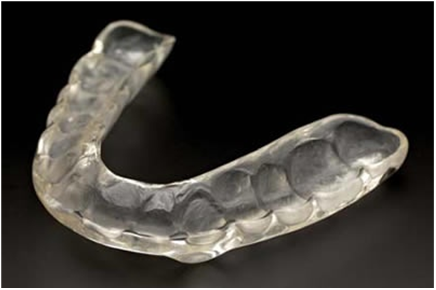
Your dentist may recommend a splint to treat your TMJ. A splint is a removable dental appliance that covers several or all of the upper or lower teeth. Constructed in a dental lab, splints are typically made of hard acrylic resin and molded from an impression of your teeth. After the splint is made, the dentist will fit and readjust it. You will be expected to wear it at the recommended times (all day, only at night, both), as well as to come in for follow-up appointments to check on how your symptoms are progressing and to have the splint readjusted, if necessary. Your dentist will advise you about how to best care for the splint.
How to Report a Device Problem
Should you be experiencing ANY type of TMJ device problem, it is important that you report these issues to the FDA’s MedWatch system.
According to the National Institutes of Health website on TMJ, “if a splint is recommended, it should be for a short time and should not cause permanent changes in the bite (move jaw forward/back or cover only certain teeth).” If a splint causes or increases pain, the National Institutes of Health brochure on TMJ says you should stop using it and see your provider who made the splint. It is advised to ask the dentist specifically if the splint he/she is planning for you will change the position of your bite/jaw. In addition, there are a number of questions below to ask.
Also, some patients may find wearing a splint causes or increases clenching and grinding. If this is the case, you should stop wearing it and talk to your dentist.
What is the Purpose of Using a Splint to Treat TMJ Problems?
Patients should be aware that various dentists may offer different reasons for proposing the use of a splint in treating your jaw problem. There are two broad categories:
- The splint is intended to provide relief from pain and improvement jaw function so it can move smoothly.
- The splint is intended to be a first step in a multi-step procedure. Wearing it will produce changes in the bite and in jaw positions, which will require some form of major dental treatment, such as orthodontics, crowning teeth, etc. to establish a new permanent jaw position.
The second approach is not supported by current scientific evidence and poses serious risks because of its irreversibility. Therefore, before proceeding with using a jaw-repositioning splint, you should ask your dentist some or all of the questions listed below.
Types of Splints
Splints are known by a wide variety of names such as: intraoral appliance, stabilization appliance, occlusal appliance, interocclusal appliance, repositioning splint, bruxism splint, night guard, mouth guard, and others with names denoting commercial vendors promoting particular designs.
There are also several distinct types of splints:
- Stabilization or flat plane splint. This splint covers all the upper teeth, and its flat surface is intended to help reduce tooth grinding and relax your sore jaw muscles. However, it does not prevent tooth clenching because the lower teeth can still contact it. Therefore, in some patients, their condition can be aggravated by the splint.
- Anterior biteplane. This splint fits on the upper jaw and makes contact with only the six lower front teeth. Thus it keeps the back teeth from touching and prevents both clenching and grinding. It is generally worn only at night because constant wear may allow the back (posterior) teeth to shift.
- NTI-tss (Nociceptive Trigeminal Inhibition Tension Suppression System). The NTI appliance fits on the upper front teeth and is designed to prevent tooth clenching and grinding. However, because it fits on only a few teeth, it places a great deal of stress on them and that can be harmful. Also, because of its small size, if it comes off during the night, there is danger that it could be swallowed or aspirated.
- Repositioning splint. This splint is used to move the lower jaw either forward or backward, either to “recapture” a displaced (clicking) disc or to establish a “better” jaw position. Prolonged use (over six weeks) raises the risk of permanent changes in the bite that can be extremely harmful, long-term damage to the joint, and increased pain, requiring further treatment and possibly including surgery.
- Over-the-counter splints. These are occlusal splints that are sold in stores. They are made of a type of plastic that softens when warmed, and you can then mold the splint to fit over your teeth. It is difficult to obtain an exact fit and they can cause permanent changes to the bite by moving the teeth.
- Sport mouth guards are used by people engaged in contact sports to protect the teeth from injury. These are not designed for use in patients with TMJ problems.
Safe and Effective?
According the 2020 National Academy of Medicine report, “Data regarding the effectiveness of intraoral appliance therapy in the treatment of TMJ is generally of poor quality and yields mixed results…Because of the hundreds of variations in intraoral appliance design, it is unlikely that any study could ever be conducted that will be considered sufficient to a particular dentist with a pre-existing belief about the effectiveness of one appliance. Simply stated, some dentists regard the evidence associated with procedural-based treatments as suspect unless the treatment was done ‘in my hands’.”
“The harms associated with intraoral appliances are less well understood. The [NAM] committee was not aware of any specific literature that describes complications associated with intraoral appliances. Anecdotally, these harms include alteration in the occlusion or position of the teeth, aspiration of very small appliances worn on the anterior teeth, dependence on a device, not acquiring self-management skills, and perpetuation of a belief that something is wrong with the masticatory system such that the appliance is necessary to “fix” it. Systematic research is needed to assess harms associated with occlusal appliances.” (NAM 5-15)
News Alert: TMJ Device (AGGA) Causing Patient Harm
Dental patients complain of harm from an unproven dental device – Patients report irreparable harm by an unregulated dental device. An investigation by CBS News and Kaiser Health News found the device that allegedly left a trail of mangled mouths has not been reviewed by the FDA. Read more
$$$$
Some dentists require that you sign a contract for splints and/or a whole treatment “package” before they will make and fit your splint. This may include the kinds of treatment procedures described above in category 2. Please be aware that by signing a contract for thousands of dollars in advance of the procedure, in many cases, you are committing to pay the full amount of the contract even if you are unable to wear the splint due to pain and or dysfunction.
Splints can cost thousands of dollars – multiple appointments are scheduled for initial and follow-up examinations, as well as fittings. Due to the lack of scientific evidence verifying safety and effectiveness of splints, neither medical nor dental insurance may cover this treatment. Make sure to check with your insurance carrier in advance.
Questions to Ask Your Dentist
- What are my other treatment options?
- What is the splint going to do for me?
- Why are you recommending this kind of splint to me?
- Are you recommending this splint to decrease my pain and relax my jaw muscles, or is your goal to reposition my bite?
- Is there a long-term goal of permanently repositioning my bite or my jaw? Or will I be able to discontinue using this device once my symptoms improve?
- What happens if my pain gets worse while wearing the splint?
- What happens if I develop changes in my bite after wearing the splint?
- Do I wear the splint during the day, night, or both?
- How long do I have to wear the splint to feel improvement?
- If the splint doesn’t help, what are the next steps?
- How many follow-up treatments will be necessary, and how much will each visit cost?
- Will insurance cover the cost of the splint and the follow-up treatments?
- Must I sign a financial contract with you to begin treatment?
We thank Charles S. Greene, D.D.S., Clinical Professor, Department of Orthodontics, UIC College of Dentistry, Chicago, IL for his many years as the TMJA’s clinical advisor and assistance in writing this section.